THE HUMAN FACTORS
BEING A ROLE MODEL AND IMPLICIT LEARNING
In technical teams, real learning happens through people, not procedures. While training provides knowledge, behavior is shaped on the job through implicit learning and role models. Senior technicians and leaders influence safety culture not only by what they say, but by what they consistently do. Their daily actions silently teach younger staff how to work, decide, and behave. Strong role models turn training into practice, protect safety, and build real teams.
We know that one of the most important social competencies for technicians is teamwork. One of the fundamental requirements for a group to become a real team is leadership. In technical teams, leadership appears as a key responsibility of highly experienced and senior technicians. It can also be stated that leadership is a responsibility for technicians holding managerial titles such as Chief, Lead Technician, or similar positions.
A senior technician who possesses the qualities required for leadership may, perhaps without even realizing it, perform a critically important function for young technicians who are new to the system or already part of it: being a role model. In other words, setting an example.
When we examine the sub-dimensions of teamwork competence, we can see that all of them are oriented toward developing correct and appropriate attitudes. An experienced technician who demonstrates the right behaviors in line with these attitudes not only performs their job safely and correctly, but also creates a positive influence on all team members.
Today, maintenance organizations, airlines, and ground handling companies that are aware of how human development contributes to organizational development—and how this directly affects safety—provide additional training for their managers and senior employees on being role models. In this way, they both create new learning opportunities and reduce training costs. How? Let us examine this together.
THE LEARNING PROCESS
Learning can generally be defined as a permanent change in behavior that occurs as a result of repetition or experience. Accordingly, learning has three basic components:
Behavioral change (observable or measurable),
Emerging through repetition or experience,
Showing continuity over time.
On the other hand, learning occurs in two main ways: conditioning and cognitive learning. Because of its relevance to role modeling, this article will focus on cognitive learning.
Cognitive learning processes are complex due to their structural characteristics. This type of learning occurs in the human brain. We constantly learn by reading, watching, and listening. Cognitive learning refers to the evaluation of information through mental abilities such as understanding, perception, memory, and thinking. The main focus of this type of learning is the accumulation and processing of knowledge. In other words, experiences are stored and given meaning.
Cognitive learning can take different forms. Let us briefly examine them.
Implicit Learning
This can also be described as learning without awareness. In this type of learning, a person learns without the intention to learn, without realizing that learning is taking place. For example, while reading a book, we may unintentionally memorize the lyrics of a song that plays repeatedly in the background. Our goal is not to learn the lyrics, yet they become embedded in our memory.
Learning by Role Modeling
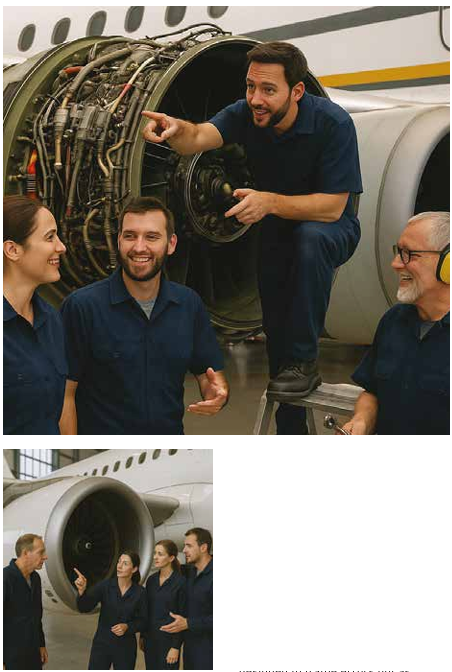
Learning by role modeling occurs when a person observes, admires, and imitates someone they like for certain qualities and learns to behave in a similar way. For example, an individual may take one of their teachers as a role model because of one or more of their qualities and strive to resemble them. This type of learning involves a degree of imitation. People learn by observing those they regard as references and who appeal to them with their characteristics.
Learning Through Insight
Learning through insight occurs when the relationships among the components of a problem situation are discovered through evaluation and reasoning. In this type of learning, the solution seems to appear suddenly as a result of reasoning. For example, while working on a difficult problem, one may suddenly see the connection and reach the solution. This type of learning usually occurs more frequently in formal educational environments.
The Impact of Learning Pathways
All of the methods mentioned above are effective in cognitive learning processes. However, it should be emphasized that implicit learning and learning through role models are the most prominent and widespread. We acquire a large part of our learning in working and social life without realizing it and/or by observing examples that appeal to us. Some studies show that nearly two-thirds of total learning occurs in this way.
For this reason, implicit learning and role modeling stand out as the main focus of this article. Let us now take a closer look at this topic in the context of the aviation industry and technical teams.
BEING A ROLE MODEL IN THE WORKPLACE
Technical teams receive regular training in all required subjects. Among these are human factors trainings, which also include behavioral components. Both theoretical and practical knowledge are shared. In addition, in on-the-job training, great effort is made to transform knowledge into skills. Furthermore, technical personnel are kept up to date through mandatory documentation they must follow in their daily work.
However, we must not forget:
“People do not look at your words; they look at your feet.”
As this anonymous saying clearly expresses, real-life situations encountered in maintenance operations are far more decisive than any formal training or documentation.
For example, a newly hired technician is taught to perform tasks strictly according to documentation and not from memory. The importance of this is emphasized in training. However, when they enter the field and see that work is done from memory, outdated revisions are used, and this occurs repeatedly, the knowledge gained in training will gradually fade. Instead, what they unconsciously absorb from the environment and from their role models will take its place.
They may begin to think: “This is taught in training, but in real life things are done differently.” If they try to resist or criticize what they see, they may fear exclusion and eventually adapt.
Now let us look at the positive side of the same example. If the technician sees experienced colleagues strictly following documentation—and even witnesses a Chief Technician intervening to replace an outdated revision and reporting it as a non-conformity—this technician will gain learning far beyond what was taught in training.
After experiencing such examples repeatedly, the technician will begin to demonstrate the same behaviors without conscious effort. Moreover, they may adopt other positive traits of these role models and develop additional skills.
THE PSYCHOLOGICAL DIMENSION
Beyond learning, this subject also has a strong psychological dimension. Research shows that people tend to respond in a way that mirrors the behavior they encounter. If someone communicates with us respectfully and honestly, we respond in the same way. If they are rude or insincere, we often mirror that as well.
In daily life, we can easily observe this: If we offer a colleague a ride home, we are likely to see them return the favor later, perhaps by bringing us a coffee. This reflects the natural tendency to reciprocate positive behavior. Unfortunately, the same is true for negative behavior.
Consider a young technician whose supervisor asks for their opinion, listens, and responds appropriately. Even if their suggestion is not used, this behavior will encourage the technician to be more supportive and engaged in future tasks. Over time, they may even adopt this behavior as a role model and strive to act in the same way.
CONCLUSION
The examples above show that learning occurs largely through implicit processes and role modeling. Therefore, experienced staff and those in leadership positions carry a critical responsibility: to be the right role model.
Inexperienced technicians will unconsciously absorb many behaviors from senior staff—not only during tasks, but even during breaks or casual moments. They will observe, imitate, and adopt what they perceive as positive.
For this reason, the number of positive role models within an organization is of great importance. Some aviation organizations provide specific training on role modeling to managers and senior operational staff to reinforce formal training through real-life practice.
This approach increases the likelihood that desired behaviors will be learned naturally and correctly, even when time constraints limit formal training. It also lays the foundation for the development of safe and appropriate behavior.
Ultimately, this is not only the responsibility of aviation organizations, but also the personal responsibility of every experienced professional within them.
Wishing you safe and enjoyable work.